



The reconfigured import barometer aims to enhance understanding of the scale and nature of sustained import increases that are impacting EU industry and the EU internal market.
On 7 April 2025, European Commission President Ursula von der Leyen set up an import surveillance task force focused on import surges caused by trade diversion in the wake of significantly increased tariff levels in certain major global markets.
The task force’s evidence-based approach provided valuable insight into trade flows and strengthened the EU’s ability to protect its open market from unfair import competition. It also served as an important basis for engagement with EU industry and an improved understanding of market dynamics.
Since spring 2025, the trade landscape has changed as tariffs have de-escalated, reducing the incentive to divert trade. At the same time, the main concern expressed by EU industry shifted from the effects of trade diversion to the rise of imports driven by industrial overcapacities, often fuelled by state-led policies and support measures, and their impact on EU industrial production.
To address these concerns, in June 2026 the Commission is revising the methodology previously used to monitor trade diversion and establishing an import barometer to focus on longer-term, sustained increases in imports at decreasing prices that reflect the systemic nature of such pressure.
The import barometer aims to improve collective understanding among EU stakeholders of the scale and nature of sustained import increases, and to inform decisions and actions to protect the EU’s internal market, its industrial base and, ultimately, its economic security and prosperity.
Import monitoring results
To address the risk of injury to the Union in a targeted and evidence-based manner, the Commission will publish on a quarterly basis a list of products exhibiting sustained increases in imports at decreased prices.
The list is drawn from the results of an automated dashboard, based on Eurostat data, which monitors import trends at CN 8-digit level, the most detailed level available. The dashboard identifies goods where imports meet all the following criteria: EU production, anabove average increase in import volume from all origins over the last two years and a decrease in price in the last year. These criteria were selected because rising import volumes combined with falling prices may indicate that imports are causing, or are threatening to cause, injury to Union producers.
- Latest barometer results and explanatory note
- Barometer methodology for establishing the list of products
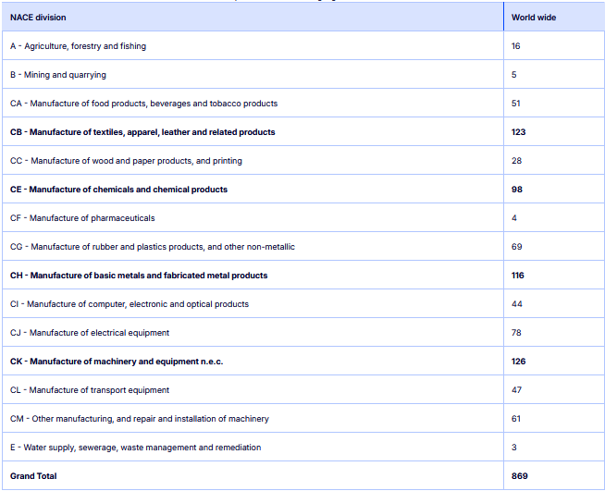
The distribution across industry sectors and origins of codes meeting the barometer’s criteria give an indication of which sectors are the most affected by increased imports and which origins contribute to these increases. The tables below, based on the dashboard, summarise these analyses.
The first table presents the number of codes per NACE division that meet the ‘import barometer’ criteria for total imports (WW) in the period analysed, and highlights the four NACE divisions with the highest number of codes flagged.
The second table highlights by colour the (groups of) origins with the highest number of flagged codes in each NACE division.
Analysis for the period April 2025 to March 2026
The table shows the number of codes flagged per NACE division for imports from all origins (worldwide).
Top 4 NACE divisions highlighted in bold
Origins or origin groups with highest number of codes flagged per NACE Division

Protective action: Input from EU industry
To protect EU industry, the Commission stands ready to mobilise the EU’s trade defence toolbox:
To assess whether and which products may warrant protection, while avoiding any unintended effects on other producers downstream and the EU as a whole, the Commission will complement these findings with relevant information received from:
- EU industry;
- Member States, and;
- experts.
The Commission therefore calls on EU producers, associations and Member States to review the results and, where warranted, provide further market intelligence and data on the economic situation facing industry.
For that purpose, interested parties in the EU (producer associations, companies, or groups of companies) are invited to fill in this questionnaire and send it (along with any other relevant input or questions) to TRADE-IMPORT-MONITORING@ec.europa.eu.
Source: EU-Site https://policy.trade.ec.europa.eu/
https://policy.trade.ec.europa.eu/enforcement-and-protection/trade-defence/import-barometer_en